I guess if you stick with something long enough, eventually you either surpass your mentors—or, more realistically, you simply reach the point where you have to start trusting your own observations. I certainly don’t think I’ve surpassed mine. In fact, I’m still a firm believer in Bill Gammel’s Five Essentials. Those principles remain the foundation of everything I do.
But over the last several years I’ve been chasing casting problems that traditional advice wasn’t solving. Eventually I quit asking permission and started experimenting. I never abandoned the fundamentals; I simply began looking for different ways to achieve more advanced casting goals while staying true to them.
Those experiments eventually led to things like:
- a slide-loading back-cast presentation
- my hinge (or “trebuchet”) grip using the ring and little finger tucked beneath the reel
- my own variation of the saltwater quick cast, inspired by MCI JF’s version
- and several other techniques that I now use regularly
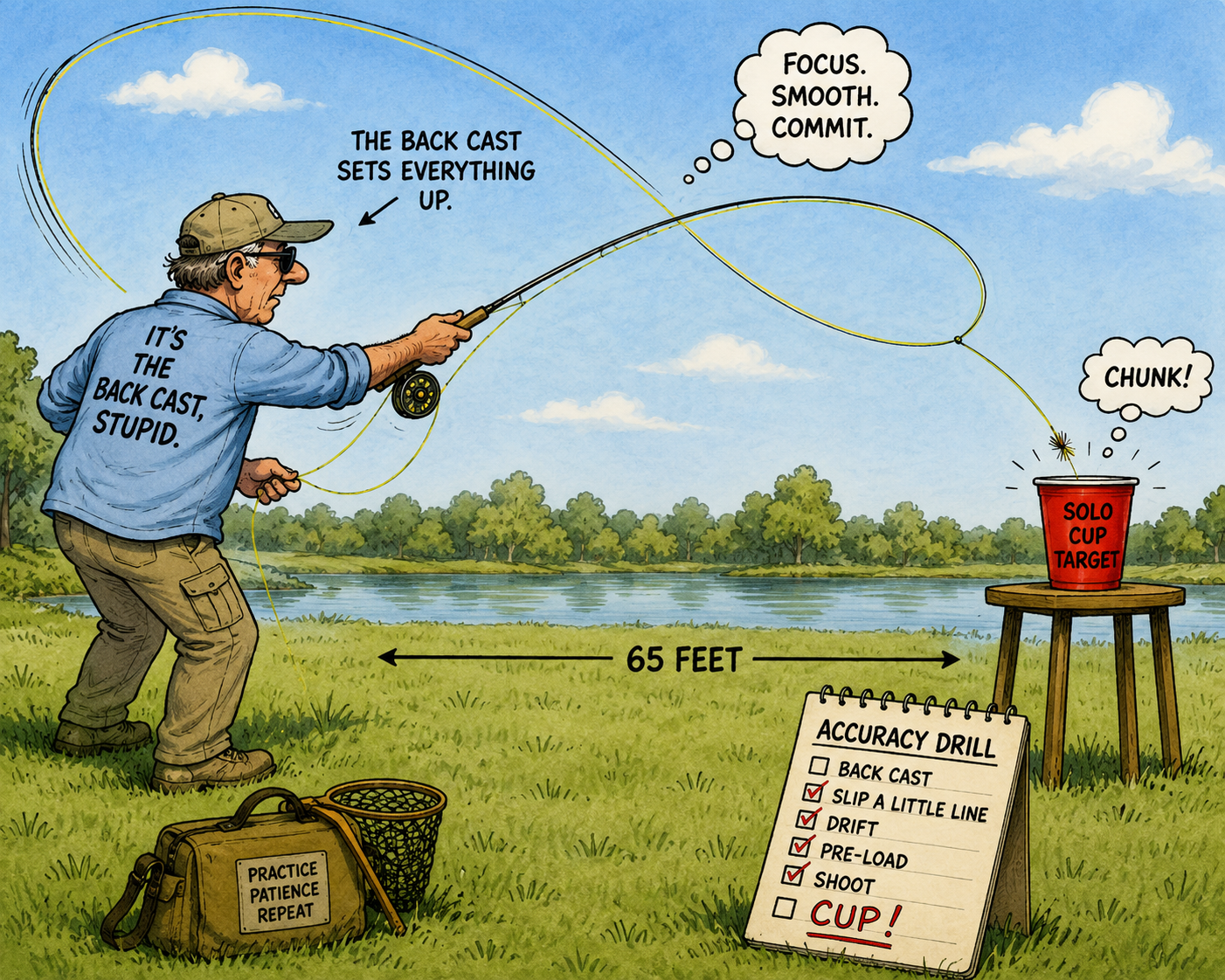
One of those experiments was the slipped pre-load. I’m convinced it improves my accuracy. Every now and then, just to keep myself honest, I’ll spend a session casting strictly the traditional way. Before long I begin missing targets I know I should be hitting, and I find myself quietly returning to the slipped pre-load. Borrowing from The Mandalorian, I simply remind myself, “This is the way.”
Lately I’ve been practicing accuracy with a red Solo cup placed sixty-five feet away. Kelly Galloup has said that’s a difficult target, and he isn’t kidding. I only occasionally drop the fly into the cup, but that’s almost beside the point. The drill forces precision.
I’m shooting line the same way I would in saltwater rather than hovering over the target. Personally, I think hovering has limited value. Fish rarely give us the luxury of continually drifting a fly in the air over their heads, and once you’re shooting line beyond the head length, hovering really isn’t an option anyway.
Before the Solo cup I practiced with hula hoops and then meatloaf pans. Eventually I realized I’d become satisfied with casts that simply landed somewhere inside a large target. A Solo cup doesn’t let you fool yourself. It quickly exposes every little inconsistency in your casting stroke.
As my results gradually improved, I noticed something interesting. Slipping just a small amount of line during the back cast—allowing a controlled amount of fly line to slide through my line hand—then drifting before applying the pre-load seemed to produce noticeably better accuracy. The more consistently I performed that sequence, the more consistently I challenged the cup.
That observation started bothering me in the best possible way. Why should it work?
I wrote about some possible explanations in an earlier post, Slipped Pre-load for Accuracy and Distance, and I still think those ideas have merit. But I couldn’t shake the feeling that something else was happening.
So I asked people who know more than I do.
One master caster, an instructor whom I respect greatly, pointed to Maxine McCormick. He observed that she appears to pause just a little longer, allowing the back loop to open slightly before beginning the forward stroke. Of course, Maxine’s timing is extraordinary and nearly impossible for most of us to duplicate, but the effect is a flatter back cast and, ultimately, a straighter pull toward the target.
Ironically, this same instructor had previously taught me something similar while demonstrating an overhead curve cast. He called it “killing the back cast”—deliberately allowing the back cast to flatten before starting forward. It’s not something a beginner should try, but in experienced hands it’s another way of controlling the back cast. Most instructors teach beginning casters to begin the forward stroke while the back cast still resembles a candy cane. Advanced casters sometimes bend that rule for a reason.
I also contacted another respected caster whose website does an excellent job explaining the physics of fly casting. Reading his work gave me another idea.
My working hypothesis was that briefly checking the line after a controlled slip might change the way turnover develops by speeding up loop travel and propagation. If that’s true, then perhaps I wasn’t really “timing” the back cast at all. Instead, I was creating a more repeatable turnover that consistently told me when the back cast had straightened.
I hoped he’d tell me I was onto something.
He didn’t.
In his opinion, slipping line during the back cast probably has nothing to do with accuracy.
Fair enough.
Maybe my theory is wrong. Maybe the physics are different than I imagine. But after thousands of casts at that little red Solo cup, I’m convinced that something is happening.
For years I assumed accuracy was mostly about what happened on the forward cast because that’s where we watch the fly. Lately I’ve begun wondering if the opposite is true. By the time the rod starts forward, much of the cast has already been determined. If the back cast is consistent—its direction, its tension, its timing—the forward cast almost takes care of itself.
I’ve dropped the fly into that Solo cup more times than I ever expected, and I’ve missed it by inches hundreds more.
Every time I do, I find myself thinking exactly the same thing.
It’s the back cast, stupid.
 "Samurai" Fly Shop