Pumpkin chunking is the sport of hurling a pumpkin by mechanical means for distance. Devices range from slingshots and catapults to centrifugals, pneumatic cannons, and — most fascinating of all — the trebuchet.
Whenever I’ve watched one fire, I’m struck by how much stored energy sits in that wooden frame. A massive counterweight drops, the long arm swings, and for a brief moment it looks like physics itself might come unglued. The whole machine feels barely under control — which is part of the appeal.
But this is a fly-casting post, so somehow I’m going to connect medieval siege engines and pumpkin artillery to a trout rod.
No, I haven’t been dropping acid.
The Hinge Grip
For some time I’ve used what I call a hinge grip for tracking. I hold the rod low on the cork, just above the reel, lightly pinching it between my thumb and index finger. The upper portion of the grip remains free to move slightly in my hand under inertia — like a hinge.
Yes, this departs from the traditional “thumb-on-top” grip. Some instructors might consider that heresy. But for me, the hinge grip reduces unconscious steering and helps keep the rod in plane.
Recently I’ve added something else: deliberate use of the ring finger during the final stroke.
If someone were watching, they might not notice anything unusual until the last back cast. I subtly raise the rod handle using just thumb and index finger, allowing the butt to hinge slightly. Then, during the forward stroke — in coordination with the haul, elbow drop, and rod translation — I engage the ring finger and close the hand.
Done correctly, this adds force and, more importantly, refines the timing of rotation.
The Trebuchet Analogy
Here’s where the trebuchet comes in.
A trebuchet works because it converts a short, heavy drop into high tip speed through leverage. A long arm pivots around a fixed point. The counterweight falls a small distance; the projectile at the far end travels much faster and much farther.
In casting, the energy source is different — muscle instead of gravity — but the mechanical principle is similar. The ring finger effectively becomes a pivot anchor during the final rotation phase. The rod rotates around a more stable fulcrum in the hand, improving mechanical efficiency.
That subtle hinge action allows:
- A slightly extended stroke
- Cleaner timing of late rotation
- Improved energy transfer
- Higher tip speed
The key is not brute force. Just as a trebuchet is about leverage, not arm wrestling, the hinge-and-ring-finger combination is about efficient rotation at the right moment.
When it works, the rod tip accelerates smoothly rather than abruptly. The loop tightens. Distance improves. And it feels less like pushing and more like releasing stored energy.
Yes, It’s a Silly Image
For effect, I asked ChatGPT to draw a cartoon of a trebuchet with a fly rod as the throwing arm.
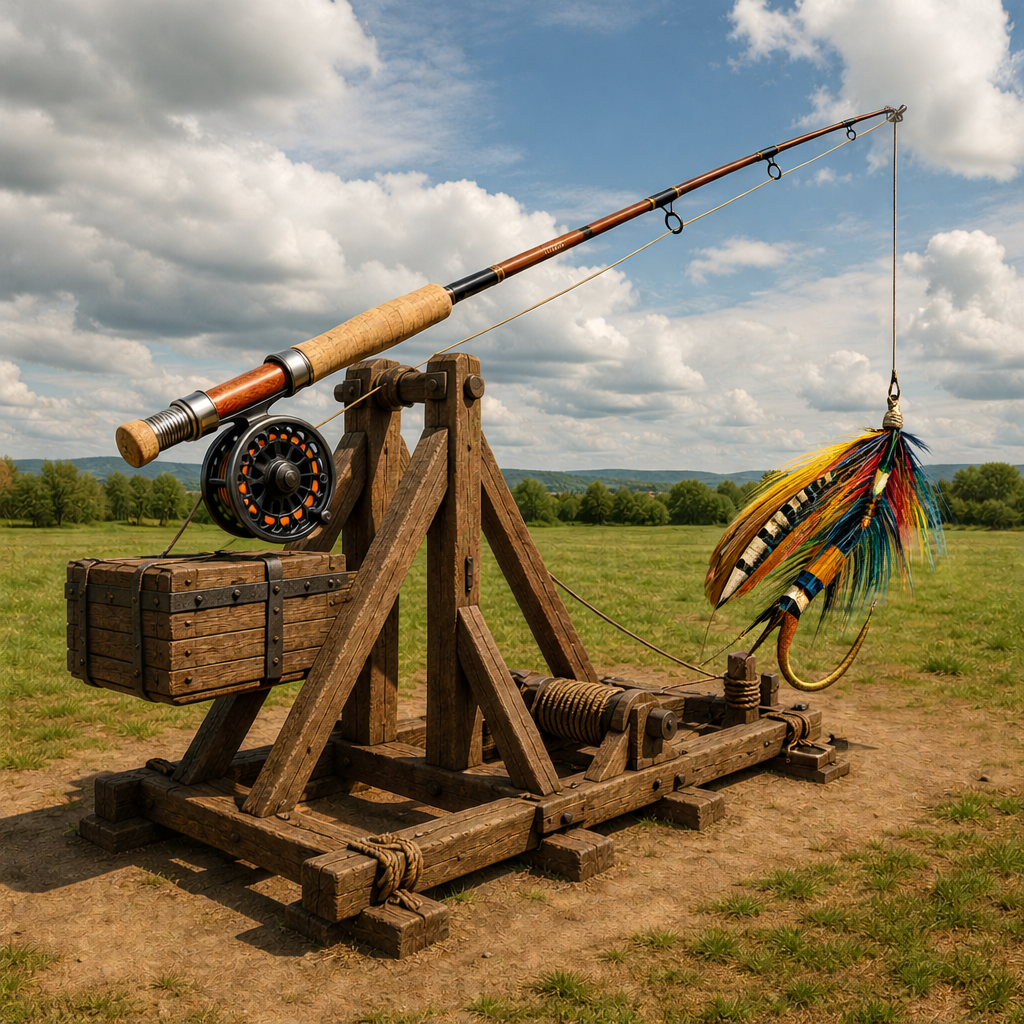
It’s ridiculous.
But the idea isn’t.
Using the ring finger in a hinge grip does create a lever effect that can amplify tip speed — much like a trebuchet’s long arm magnifies velocity at its far end. The scale is different. The principle is not.
Both systems rely on leverage to magnify speed at the end of a rotating arm.
And Because Why Not…
To make the post fully bizarre, I also asked for a poem about a trebuchet with a fly rod arm.
And I have to admit — it’s pretty good.
 "Samurai" Fly Shop