
I ‘ve been doing it all wrong. Yep. Last year I thought my little neighborhood lakes were fished out due to a number of my neighbors allowing friends to come in and bait fish the heck out the lakes. But that’s just typical fisherman thinking in that if you’re not catching fish then “somebody else is to blame!”.
This year, I’ve been going out to the lakes just before dark, not deliberately but by the fact that in the late winter there is very little light. There is just enough time and light to get in a little fishing. Due to the late fishing, I have figured out that the big bull bluegills are still there. The kicker is that they are, contrary to public opinion, hard to catch. I slowly started hooking up with the big gills right around dark and the bite got better each day as the weather warmed. Once I made the realization that the big bulls were feeding late, I changed my routine to simply go fishing right before dark. The big Brimski’s are feeding on midges. I know there’s a midge hatch because the midges (which bite) are swarming so bad I have to wear a head net to be able to stay out there. This midge thing happens in early Spring. I’ve always had problems with Buffalo Gnats in early Spring turkey hunting. I think these midges are different because they are smaller. The midge activity is somehow acute to the early Spring, in my own anecdotal determination.
There’s not much time once the big bulls start rising and I have developed a few techniques using my hard earned single-hand spey casting skills. Mind the fact that I am bank fishing with numerous trees around. I can overhead cast but only in certain directions. When I see a rising bream, I raise the rod, slipping line out as I raise it until I have about a foot of overhang, then I use MCI Jeff Ferguson’s elbow drop roll cast to roll the fly out into the middle of the ring. It’s faster than an overhead and I don’t have to worry about my backcast.
I always throw to middle of the ring because that’s what makes sense. It’s what we do in saltwater when we see a jack blow up on the water. I can hear my guide in my head now as he screams “throw it in the hole!” It may be counter intuitive to throw where a fish WAS, but it’s the right thing to do because when a fish blows up or takes on the surface, often they will just circle right back around. Since you don’t know which way he might have gone, that’s the only safe bet you have is to throw where he will be if he makes a circle or, possibly, he may hear the fly and come back. Doesn’t always work, but it certainly works better than assuming he went in a particular direction. You can’t read their mind.
When it is windy I use a subsurface bead-head nymph and when the water is calm I use a Griffiths Gnat.
I also use a snake roll to quickly change directions and after I roll it I don’t just drop it on the water in the new direction, I use the load to cast immediately without the line touching the water to keep the surface disturbance to a minimum. Again, thanks to MCI Jeff Ferguson for his instruction at Red Stick Day. I would use a Perry Poke or Tongariro but from the bank, you won’t have enough room to make a loop on the water because the bank is in the way. The snake roll and the elbow drop are the two casts that get a fly into the ring quickly when the trees won’t let me use an overhead cast.
I usually will start catching the medium size fish about thirty minutes before too dark to fish and fifteen minutes after that the big bulls will start taking. I’m not sure if they would continue rising into the night because when it gets too dark I just can’t operate. I do seem to notice that the activity seems to shut down when it gets too dark.

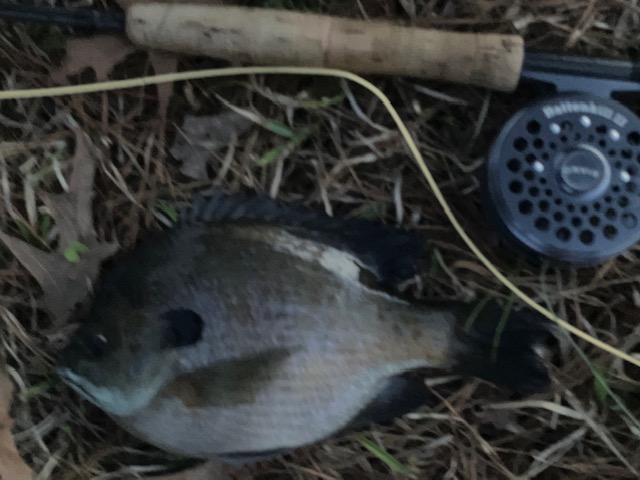
So anyway, that’s what I’m doing. Please don’t think I’m trying to foist my “expertise” on you, I just think folks might be interested in what I’m doing since this seems to be working and I’m having fun plinking bream in the evening.

 "Samurai" Fly Shop